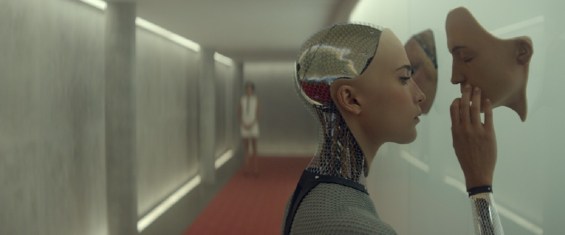
 This Saturday, I finally got to see “Ex Machina” with my boyfriend. It’s something we’ve been planning for three weeks – that special. The film is somewhat of a medium-budget Indie film by the director of “28 Weeks.” The film deals with a lot of interesting concepts – AI, human-robot relationships, deception, attraction, the drive for survival, and people’s moral compasses. I was first intrigued by the film because it had to do with a human tapping into the unknown – a fembot who responds physically and emotionally to the male protagonist. I thought it to be a provocative concept.
In the film, a young coder in his mid-twenties, named Caleb, wins a chance to stay a week at a secluded state-of-the-art home inhabited by Nathan, his company CEO, a genius who programmed the top-used search engine, Bluebook (similar to Google). During his stay there, things suddenly turn from thrilling to awry in a matter of minutes, as he realizes he’s trapped in a Turing test that he has to sign an NDA for, and finds himself locked into a modern home of weird trap doors made of frosted glass, pockets of man-made nature, and the founder himself; Nathan, amoral, constantly inebriated, but brilliant, has created an artificially intelligent fembot prototype, which is his prized creation, and he puts Caleb through the test of validating her existence. The latter part is where feelings get involved, and decisions become murky.
Caleb reluctantly agrees to participate in a series of interactions with Ava, who’s programmed with a soft face, curves, and an inquisitive personality, as a part of the Turing test; he tests just how “human” she’s been programmed to be. How convincing she is human becomes the ultimate tension in the film. Caleb, over time, develops feelings for Ava, who displays clear attraction and a desire to be with him – after the “test.” Caleb slowly falls for her, despite their interactions being limited to being behind glass walls – the tension that builds is artfully done. Towards the end of the film, Caleb becomes a puppet between the two characters – Ava and Nathan. He slowly unravels, as he’s not sure who to believe is telling the truth. Nathan, the maniacal CEO who’s obsessed with building the perfect AI artifact, or Ava, a fembot who wants nothing but to be with Caleb and repeatedly expresses undying devotion to the concept of being with him in the free world.
I came to two startling reactions from the film. How much the film parallels to Bluebeard, the French fairytale about a maiden who is wedded to a powerful aristocrat and later discovers his grisly secret – a room filled with his dead wives, whom he’s killed off because of their untrusting nature. [Spoiler Alert: You see a glimpse of this in Nathan’s bushy black beard, his company named Bluebook, and unanimously so, his bedroom filled with closed hanging closets that are filled with the deathly hanging bodies of earlier versions of the AI prototype he’s created.]
In addition, I thought it was interesting how the film dabbles with ‘attraction’ that builds between man and a robot. Despite there not being any sort of true sexual orientation and biology (hormones, estrogen, testosterone) that comes into play when attraction develops, what occurs between Ava and Caleb starts as pure conversation through openness and intimacy with each other. Openness because Ava asks Caleb to be open, and intimacy, because Ava, like Alice peering in to the Looking Glass, is programmed to read Caleb accurately and intrinsically due to her state-of-the-art capabilities. This forces them to confront feelings, emotions, desires, and anything awkward in the spaces between. What started as “Hi, tell me about yourself” becomes a sharing of childhood trauma to compliments about physical appearance to eventually plans for escaping together as a couple. Similar to the film “Her”, which awkwardly was one of my first movie dates with my boyfriend last year, “Ex Machina” deals with a man falling in love with a machine that at least sounds like a female. To that, I asked June what he thought of Caleb and his attraction for Ava, and he agreed that it’s plausible, and that feelings can grow based on conversation interactions between the two, which grew in familiarity, depth, and intimacy. My intrigue with this cross-platform love comes from our relationship; it started from a one-time attraction and encounter, followed by a month of personal stories, feelings, beliefs, memories, dreams, philosophies, and desires shared daily over the phone across state lines, which wove together the fabric of our lives, before we met again for the second time.

