The Good, the Bad, and the Ugly of Instagram: 3 Tips on Social Etiquette

Instagram logo

Three days ago, I embarked on a new plan to give up Instagram (“Instagram Fast”) for two weeks. Often, I’m glued to my phone while sitting at a restaurant or scrolling through my iPhone while walking a block behind everyone else because of this app. It’s rude, unhealthy, and limits my capacity to live in the moment.

Since Instagram’s launch date in March 2010, numerous bug fixes and upgrades to v3.1.2, integration with social networking services that include Facebook, Twitter, Foursquare, Tumblr, Flicker, and Posterous, and growing device support from Apple iOS and Android, it has since seen its buyout to Facebook CEO Mark Zuckerberg and runaway success among top brands (read about the “10 Most Followed Brands on Instagram“) that use social media to engage with and market goods to its consumers.

Instagram’s success skyrocketed this past fall – as it watched Thanksgiving image uploads hit an impressive record high of over 10 million photos as well as a massive sharing of experiences during Hurricane Sandy. In fact, due to the expansive sharing of 800,000+ images in the face of calamity, Hurricane Sandy became the “most instagrammed news event ever” (click here to see about how Time’s photo journalists used the webstagram feed to uncover the event).

While I’d be lying to say that Instagram isn’t full of technical wonders – like speed/immediacy, an intuitive interface with stunning and high-quality filters, and high social engagement (likes and comments), I began to see its pitfalls.

Read my 3 tips on Instagram social etiquette:

girls-retro

1. Instagram is a poor replacement for friendship. Back in the day, friends communicated via snail mail, emails, phone calls that took place in the confines of bedrooms, speedy text messages, and good ol’ face-to-face quality time. Thanks to this photo-sharing application, friends are able to communicate their approval, affirmation, and likes by liking or double-tapping a photo as soon as it’s uploaded into a photo stream. However, when the flurry of likes don’t come or a photo of significance isn’t appreciated, a person falls into momentary panic. Yesterday, my friend said, “When I uploaded a pic of Marty (pet Daschund) last night, I was surprised you didn’t attack it.” I reassured her with my decision to temporarily break from Instagram and that I did indeed like Marty – to which she sighed a heavy sigh of relief.

hearst building instagram2. The News Feed provides unwanted monitoring. Let’s admit it – the News Feed displays a wee bit more access to a person than we’d like. The News Feed displays real time stream of activity from users you follow – likes, follows, or comments left on mutual users’ photos. Inadvertently, however, it elicits unsavory surveillance or monitoring on the people you follow, whether you like it or not. On occasion, you’ll scan past provocative images, questionable follows, or just images you end up staring at – that you had no intention or desire to in the first place. As a result, the News Feed often puts a strain on interactions with friends. “She uploaded a picture just now but didn’t text back” or “I wasn’t invited to this birthday party? FOMO!” You could say it’s a fast and dirty way to get in someone’s head – without putting yourself through the trouble of face time or going on 10 more dates.

3. Constantly documenting events, food, and self portraits takes away from living life – and is obnoxiously #TMI. A few months ago, I heard a comment on the radio about Taylor Swift’s gratuitous Thanksgiving food photos uploaded last year. Since then, I always take a moment to ensure my image uploads of food are worthy to upload, unique and of high resolution. When Instagrammers upload countless snapshots of food and deem them as food porn (#foodporn), chances are, they aren’t all worthy of such a title. Recently, I was called out by my sister while waiting for my food – busy Instagramming, uploading photos, and checking my news feed every 15 minutes; since then, I realized Instagram deters you from actually living in the moment. Instead of soaking in the sun rays, seeping in the smells and tastes, or delving deeply in a conversation with friends, you find yourself busy – documenting a moment, scrutinizing its angles, selecting the perfect filter, and uploading it for display and a stroke of your ego (“ego analytics” as Scott Belsky, CEO and founder of Behance calls it in this video).cream,desert,food,fruit,instagram,photo-30f92cf4a7c5e7f331c8d2b123e7b7c5_h

Due to this application, people can grow increasingly discontent over their own lives, dispositions, and circumstances. That’s no healthy way to live – and a misuse of a great photo-sharing application.

Bottom Line: Reality doesn’t come with filters, likes, and follows. After three days of being Instagram-free, I noticed a few welcome side effects by the end of the day: undrained battery life, more time on my hands, obliviousness to society, and joy. While sitting in traffic, I’ve been forced to choose the lesser of the two social media evils on my phone – reading articles in my Twitter news feeds. I’ve already listened to two podcasts in the past two days.

Life comes in much more beautiful hues in real time – without technologically enhancing photo filters, captions, and tongue-in-cheek hash tags. Life is better lived without a device to capture every moment, gloat about wins, or envy others about being in better scenarios.

But don’t get me wrong. The occasional photo uploads of milestones, moments of striking beauty, personal significance, and inside jokes, or the share-worthy dish at an exclusive restaurant or a unique cityscape in a distant town have the capacity to speak a trillion words. The sky, in Lo-Fi filter, is your limit.

4 Step Approach to Set Up, Run, and Execute a Successful Marketing Campaign

Review by: Rich Poplawski

The mobile internet will surpass desktop internet usage by 20141. Mobile is the future, but the real question is your business prepared for the shift? Are you new to the mobile marketing space and not sure where to start? Do you want to learn and understand how to set up, run, and execute a successful marketing campaign to keep your business relevant? If you answered yes to any of these questions, then read Go Mobile.

Go Mobile is a book written by two very experienced marketing guru’s, Jeanne Hopkins, VP of Marketing for HubSpot, the world renown all-in-one online marketing company , and Jamie Turner, Founder of 60 Second Marketer, an online magazine that supports marketers with tips, tutorials, and tools. Hopkins and Turner share their marketing knowledge to provide great insights that will guide anyone through the vast, extensive, and sometimes confusing world of mobile marketing.


Go Mobile is a roadmap that provides a great overview of all the pieces needed to start, run, measure, and grow mobile marketing for your business. The book provides a four step approach:

    1. Looking at the mobile marketing landscape by exploring:

    • Mobile marketing terminology, concepts and strategies
    • Successful mobile marketing campaigns, such as Starbucks mobile payment and reward application.
    • Tools that are available in the mobile space
    2. Building the foundation needed to develop a mobile marketing strategy by:

    • Incorporating fundamental marketing concepts such as Four P’s and the Five C’s
    • Knowing the different mobile operating systems and mobile service providers
    3. Gaining insight into mobile marketing tools, such as mobile web sites, SMS, and much more
    4. Managing, measuring and driving ROI

Pros:

  • Great examples of successful mobile marketing campaigns around specific mobile technologies, such as Chili’s Restaurant chain taking advantage of location based services by sending free coupons for cheese dip to anyone that checked in at or around a restaurant location using FourSquare.
  • Best Practices and tips on thinking like a consumer on a mobile device, developing a strategy, writing successful mobile ads, and measuring successful campaigns.
  • Statistics used to back their findings and prove the success of marketing campaigns.
  • Lists that provide great examples, such as successfully built Mobile Apps broken out by categories.
  • The Do This/Don’t Do This after each chapter, which provides tips and advice on expanding the knowledge that was discussed in each chapter.

Cons:

  • Too many examples of successful mobile marketing campaigns, but not enough details about the strategies, approaches, and analysis involved to make these campaigns successful.
  • No examples of mobile marketing campaign failures. Providing examples of failure creates transparency so others can learn what not to do when developing mobile campaigns.
  • No in-depth technical understanding around mobile technology, such as NFC, app building, or responsive design.

Final Thoughts:

Go Mobile is a fun, quick read that creates a great foundation around mobile marketing. The book really hammers down three basic concepts that are crucial to every successful campaign: measurability, customer insights, and innovation. If you are interested to gain a comprehensive understanding of mobile marketing and gain insights into the types of technology out there to help you build a strategy around an effective marketing campaign, then this book is perfect for you. Read Go Mobile!

1 Danyl Bosomworth, Mobile Marketing Statistics 2012, http://www.smartinsights.com/mobile-marketing/mobile-marketing-analytics/mobile-marketing-statistics/ (May 2012)

Predictably Irrational: 5 Ways How Our Brains Are Easily Bamboozled

BizzaroComics.com on Psychology

BizzaroComics.com on Psychology

Why do people spend a fortune on brand name drugs instead of generic drugs – and report more cures? Why does jotting down an honor code instantly make you more honest during an exam? Why are people more apt to steal office supplies, tokens, points, and stock options – but not cold cash sitting in a fridge? Why do people buy Diet Cokes – only to splurge on three more servings of apple pie, cake, and ice cream shortly after?

People are strange. They make irrational decisions, mistakes, and habits in classrooms, courtrooms, shopping malls, banks, and doctor’s offices every day. In the New York Times bestseller Predictably Irrational: The Hidden Forces That Shape Our Decisions, MIT behavioral economist and professor Dan Ariely set out to investigate the predictable but irrational behavior of humans in a series of groundbreaking, controlled behavioral studies conducted on a booming populace of undergraduate students at MIT. Wildly entertaining, exuberant, detailed, and conversational, Ariely provides intelligent, well-documented insight into nearly 13 seemingly unrelated factors that influence our behavior. Those oft overlooked or ignored factors are emotions, relativity, and social norms – and they come to play in the marketplace, economics, public policy, and law.

The first edition of the book, published in 2008 by Harper Perennial, falls into a popular classification of “behavioral economics” books that integrate human psychology, behavioral science, and economics to prove but one thing: human decisions are fallible. The book has garnered popularity from reputable newspapers (Click here to read what The New York Times had to say), pop magazines, entertainment digests to publishing circles and average readers with Engineering backgrounds. While I had drawbacks to Ariely’s comical and oversimplified language, the book quickly won me over with his engaging voice, personal anecdotes, a systematic break-down of irrational human behavior on a case-by-case basis, and social implications on how society and we should take heed and break the cycle; change needs to occur in ourselves, our policies, our ads, and even our buying behavior.

Read 5 compelling human behaviors that have social implications:

1. The Revolving Doors Between Market Norms and Social Norms. Market norms are strictly transactional exchanges: payments, wages, “prices, rents, interest, and costs-and-benefits” (68). Social norms are social exchanges: favors, gifts, promises, offers, and implicit exchanges made in close corridors among friends, family, and familiar individuals. Friction happens when both spheres get tangled. Say, for example, a national bank spends billions on advertising the impression of “social relationships” and offers dog treats and candy per visit; but then it regularly slaps its customers with outrageous late or overdraft fees. When market norms and social norms are mixed, customers become disillusioned and distrusting of the company. You can bet customers will take offense or switch banks. Conclusion: Companies should choose to associate with one or the other – not both – in how it manages its relationships with its employees, consumers, and the like.

2. Keeping Doors Open. People have an incessant need to keep their options open. Even if they have a “best option”, “medium option”, and “worst option”, people will waste opportunity and time to dabble between multiple options – only to regretfully see doors close on them. In the real world, there is a terrible cost to dabbling with options but not committing time, opportunity cost, and concentration on one option. For example, when parents obsessively involve their children in a range of activities like ballet, football, flute, Tae Kwon Do, swimming, and art, exhausting their children, wasting money, the worst part of it is, they lose time, money, and effort that could be spent mastering one particular gift, talent, or study that could make a difference in their children being superstars or staying average.

3. The Power of Price. People are so easily swayed by the cost of a product as positively correlating with its worth/value or effectiveness. In examining “the Placebo effect“, Ariely provides a wealth of studies that have proven that medical patients that received placebo operations and medicines experienced equal healing as did patients that received the actual operations. Implications are severe: There are countless costly medical procedures and exams that are unsupported by scientific evidence, and thus, could be done away with. Also, despite their controversy, placebo goods, drugs, and operations could be a cheap and yet successful method for curing serious illnesses or even improving test scores for the LSATs.

4. Ten Commandments, Honor Codes, and Honesty. Who would’ve thought that reading the Ten Commandments and being asked to rewrite them by memory would cause students to not cheat? Ariely provides startling implications on how reading a moral code, being primed with honest “terms”, or simply pledging truthfulness before taking an exam or speaking in a courtroom can lead to more honest behavior.

art-dollar-religion

5. Handling Cash Makes Us More Honest. How profound! People are likely to cheat more for tokens and symbolic items of value (points, answers on an exam), simply because they are one step removed from money and can be easily rationalized. While most people won’t necessarily steal cash out of wallets or a few bucks planted in dorm community fridges, they will steal office pens and food, cheat on stock options, and get away with fraud – without touching a hint of green.

After this book, I have decided to take time to rethink my choices down to the food I order at a restaurant or the coupons I choose to clip. If our irrational behavior can be boiled down to systematic and predictable factors, it’s a shame for us to proceed through life not stopping ourselves from falling for the same ads, the wrong people, or poor, dishonest decisions that cost others or ourselves. Beat the system that is the subconscious human mind.

A First-Timer’s Guide: 5 Tips on Using Facebook as a Marketing Tool

Recently, I had the sheer luck of managing client websites that used Facebook to implement their marketing.

Stepping into the mind of on-site developer Joseph, I got to see implemented social media hubs, social plugins, newsletter/e-mail sign-ups, the “Like” functionality, and the “Share” button. After hours of debating scenarios, user experiences, and testing share buttons with my trusty, fake Facebook account (which has only one friend – my actual account), I learned how Facebook can be a premier way to effectively market your goods to a captive social audience.

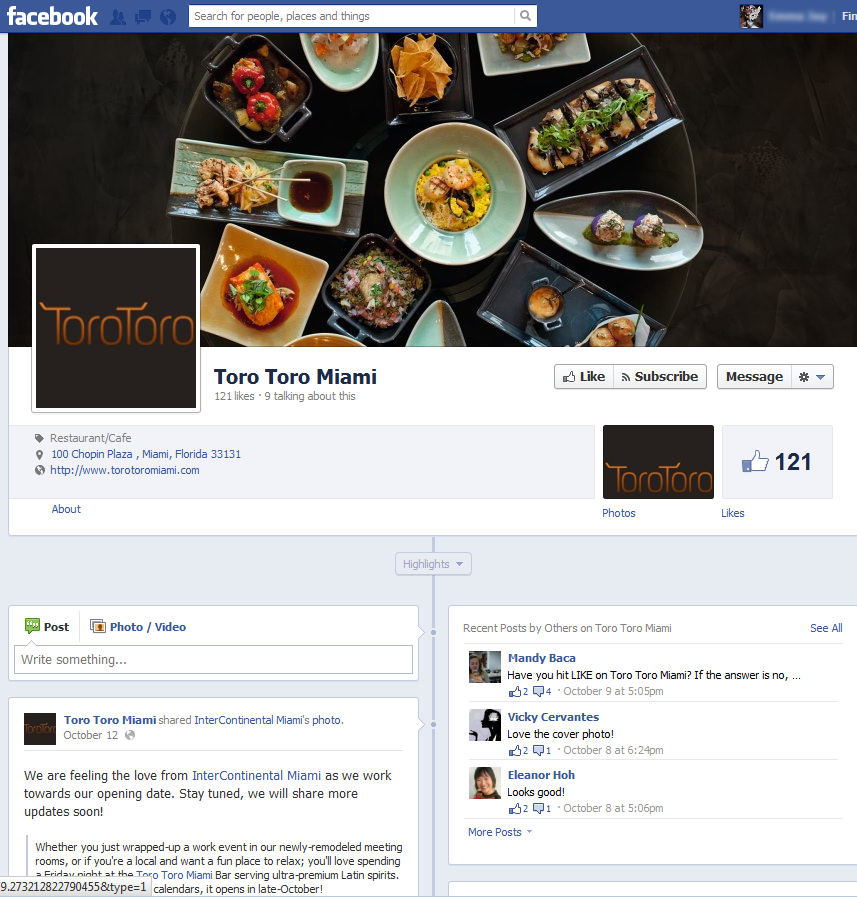
Toro Toro Miami

Toro Toro Miami’s new Facebook page

Facebook should add social value to your website without replacing it; it increases brand awareness, builds customer loyalty and retention, and makes king social media engagement between users, their friends, and your brand itself. If Facebook is now the Number One U.S. website, no wonder companies are flocking over to create their own presence.

1. Create a custom Facebook page. Present new updates and specials without losing the general layout, feel, and presentation of your current website. Upload a standard logo, memorable cover photo, photo albums, a guide or introduction destination for new visitors, events, and a call to action (booking, RFPs, requests for more information, checkouts, email/eblast/newsletter sign-ups).

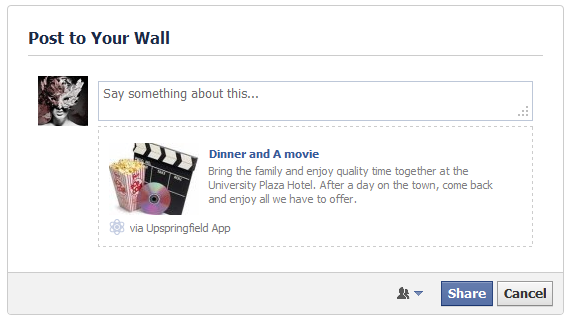
2. Engage your social audience with social plugins. Implement the “Like” functionality for the user to stay abreast of your latest and greatest updates on events and specials. Implement a “Share” button directly from your website that allows a customer to share an item or deal to his or her friends’ news feeds.  In order to do this, here are two helpful tips:

  • Get in the mind of a Facebook user. All users want to be the first to shout from the rooftops about a thing they really love. All users like to see how loud their shout reaches – who sees the posted content? Most users are narcissistic; they then want to see how their shout sounds to their relative group of friends – what does their post look like on the news feed? Lastly, all users want to see how their shout makes them look – how does this post look on their Timeline?
  • Use Facebook Developer code.  Facebook does a great job of laying out the groundwork with template code with which you change variables to carry over. Facebook even gives you example code for you to test out on your page. Here is a helpful page to get you started: http://developers.facebook.com/docs/reference/dialogs/feed/.

3. Place your call to action “front and center”. As an e-commerce merchant, you may want to use Facebook to lead to direct conversions or checkouts. Here’s an example of how a client, The Dunes on the Waterfront, implemented a reservation booking widget front and center on their Facebook page – seamlessly  carrying over their custom website images along with their very own booking widget (or social plugin).

4. Add a sign up for e-mails or newsletters. Users like to walk away with more information. Be sure to allow the user to sign up for a newsletter. The client, Visit Aurora, wanted a destination at the top of their Facebook page to allow a new user to sign up for information – with a pre-selected opt-in to receive newsletters.

5. Add a social media hub to consolidate on your website. If you can combine your social media efforts in one stop, why not? I recently worked on one client’s site that had a social media hub that combined all their social media platforms into a single feed widget. Each tab opens up to a different social media feed. Check out the site’s social media hub.

Most social media hubs aren’t so fancy and follow a basic “box” format, where all the social media icons are clumped together. Popular social media platforms commonly used for marketing are Facebook, Twitter, Google +, Trip Advisor, Yelp, and Pinterest.

Once you incorporate customizing your page, promoting it from your website, posting status updates, cross-marketing your Facebook presence from your own website (with “Like” and “Share” buttons), the fans and “likes” will start trickling in. And if all else fails, the most traditional way to market your company is through display ads on Facebook.

5 SEO Easy Steps to Improve Content and Drive Site Traffic

creativo-text-laptopManagement and upkeep of client websites require more than fixing broken links and widgets. It involves grooming, pruning, and reinventing site content – over and over, like newspaper op-eds and front page news. Believe me – as a user, I never enjoy going to the same website and seeing the same header image, banner ads, rotating graphics, and more importantly, the same content. Copy is to personality as graphics is to physical appeal. In other words, copy plays a critical role in keeping a visitor interested, engaged, expectant – and turning a user experience into a conversion (i.e., a sales transaction, inputting information, signing up for a newsletter or email blast, or simply sharing a great experience with friends using Facebook, Twitter, and Instagram). That’s why it’s important to keep a consumer interested and loyal with five easy steps.

1. Write engaging copy – Whether your content is promoting your company, property, destination, hotel, retail store, or restaurant, it’s important to present information that is web-friendly, cohesive, factual, current, and grammatically correct. This may require hiring a copywriter or editor with attention-to-detail and a finesse for writing engaging content that will allure instead of bore users who organically search for and land on your site.

Provide unique, authoritative information that will teach the user something new and unique from everything else out there. For every restaurant website, there are about a million other slightly similar websites out there with even more similar functionalities, menus, images of visually stunning food photography, and ostentatious showcases of star chefs. What makes your web presence a little bit different and stand out so a user will choose your restaurant?

website-design

2. Optimize your site’s HTML tags (keywords, phrases, metatags) – Be as SEO-friendly as possible. Most users will end up on your site organically, based on your rank in search engine results in Google, Yahoo, Bing, and smaller search engines. Thus, it’s important to bulk up your metadata with as many relevant keywords, phrases, and metatags, or else search engines won’t list your pages high up in search results. It’s kind of like fluffing up your blog entry or tweet with 20 hashtags. #cool #blog #optimize #HTML #metatags #sounds #redundant #phrases

3. Refresh your content constantly. Update your content with fresh new tweaks, revisions, and changes routinely every few weeks. Hook users in with new deals, packages, and features, and keep them consistently interested. When a user starts to catch on that the website is no longer undergoing changes, he or she smells “death” and naturally navigates to another site or vendor. Prevent that from happening!

4. Add internal links. There are two reasons for this: 1) Google loves to have its search crawlers notice individual pages with internal links on your site. 2) Internal linking increases ranking of the site’s internal pages.

5. Include a call to action! Now! Using urgent, effective, and persuasive language, add an eye-catching button, widget, video, or link, or configure a transaction form, RFP, or contact us form that engages the user to the next step. A call to action is the elevator pitch and proposal made to a prospective client or interested user. As Paul Boag says, a call to action provides three things: “focus to your site”, “a way to measure your site’s success”, and “direction to your users.”

6 Steps on Surviving a New Job … in the First Week

This week marks my first full week at a new position in a client-facing Web eCommerce company that is different from previous work environments. Work philosophy, company culture, and values certainly dictate the demands of the job – and your ability to succeed long-term in the position. Granted, three days in, my direct supervisor looked me straight in the eye and told me she was taking the “training wheels off” and letting go of my hand. Panic had set in as I realized my work would directly affect clients and their long-term conversation rates. It didn’t take very long to realize that I would have to pay my dues from the bottom up. But with a few steps, I believe any new employee will be able to handle their first week (and second and third):

1. Understand the culture. Check out what people wear, how they talk, what they eat, what they watch while they eat. It’ll definitely ease your entry into the company. But more than anything, be open-minded; no one is averse to a friendly attitude and smile. Read Harvard Business Review’s take on headphones – and how it can create isolation here.

2. Ask as much questions as possible. There is such a thing as a dumb question. However, there is no such thing as asking too many questions. Sitting through an exhaustive amount of meetings led by department heads in my first week, I found it to be a real icebreaker and educational tool for me to be interested and ask inquisitive questions about the department and how it affected me. Don’t be afraid to ask about things as granular as their ROI or how a department manages unhappy clients – or how you can help. Note: After understanding who does what, leveraging talent and unique gifts, collaboration with various work colleagues is a fortuitous step in the right direction – check out what Harvard Business Review had to say here.

3. Learn the work process. Whether it’s through shadowing, notating in a trusty notebook, keeping notes on an excel spreadsheet, memorize and devote yourself to the in’s and out’s of the work process. Of course, the best way to learn the process is getting in there and getting your hands dirty.

4. Make a few close friends. Having a friendly face you can share your work life with – not to mention, lunch – can really take the edge off a long day and break the monotony. In fact, being able to ping a coworker about life, step out for coffee, celebrate wins, make fun of each other, or just get a breather can really improve the quality of your work life. After all, work is where you spend half your waking hours; might as well enjoy the company.

5. Start your morning right with meditation. Next to coffee and breakfast, this is pretty darn important. Arriving early to work, beating gnarly traffic while you’re at it, to sneak in quality quiet time has turned out to be the best part of my work day. Like the calm before a storm, the half-hour before coworkers trickle in can be an opportune time to close your eyes, get energized, de-stress, reflect and collect thoughts, gather yesterday’s notes, lift a prayer, and ask for peace and tranquility to handle the day’s hurdles. At least it’s proven monumental for me in my first week at a high-pressure, stress-ramped job that is located anywhere from 50 minutes to an hour and 15 minutes away.

6. Don’t be overwhelmed – breathe. The first week is essentially an unloading of information – practically the entire groundwork of all the work flows, systems, and best practices required to execute your job successfully. Last week, I had two teary panic attacks after work, taking on two classes (one of which I dropped), too much pressure, too many demands, and realized that being emotionally distraught and helpless wasn’t going to benefit me, my coworkers, or my family/friends. So I decided to take a step back and see that the first week is not an accurate representation of how my work experience will really be. I decided to breathe, make phone calls, talk it out, and before I knew it, I saw that this job was feasible and not at all impossible. It gets better, more routine, and you develop a rhythm.

“The Stars Have Aligned for You”

ImageThose were the words from my mentor this afternoon after I sent her a tentative farewell email letting her know my changed career plans. I’ll be leaving my company effective next Friday to take a new job – aligned with my pursuit of a Master’s this coming fall.

It wasn’t an easy decision to make on my part. I knew I would be giving up flexibility and world-class work/life balance at my current job. I wanted to move my career into the tech industry, and the opportunity came. I took a job offer with a subsidiary of a software/hardware company that serves retail/restaurant/hotels industries worldwide. The job lead came right around the time I had finished applying for grad schools. After a strange series of events, I got accepted, enrolled in school, and got the job offer literally within days of each other. My office will be located eight miles away from Georgetown’s Clarendon campus where I’ll be starting classes next week.

I’m excited, thrilled, and scared at the same time to be getting closer to my dreams.

I’ll be frank. All of this is happening so fast. I’m just catching my breath; my digestion, breathing pace, and pace of life are coming to a normative, slower creep. I do wake up these days from nightmares – not always daydreams, over something going very wrong. I’ll be a sub-average student, or will suck at waking up at 6:30 AM to make my commute to Maryland, or I’ll get so burnt out at a fast-paced job and 20-page papers that I’ll simply die. I’ll get caught sleeping through a meeting or, worse, in class, covering my desk in drool and ruining my chance of ever finding common ground with my fellow classmates. Just kidding!

I’m thankful to God, family, and those who stood by me as I regrouped and transitioned as a post-undergrad, with no idea what I’d do with journalism. I have no guarantees on how things will turn out – only more dreams on how I’ll get there. I’m officially a dreamer.